
Acoustic Office Pods for Open Plan Offices: The Size-by-Headcount Buyer Guide
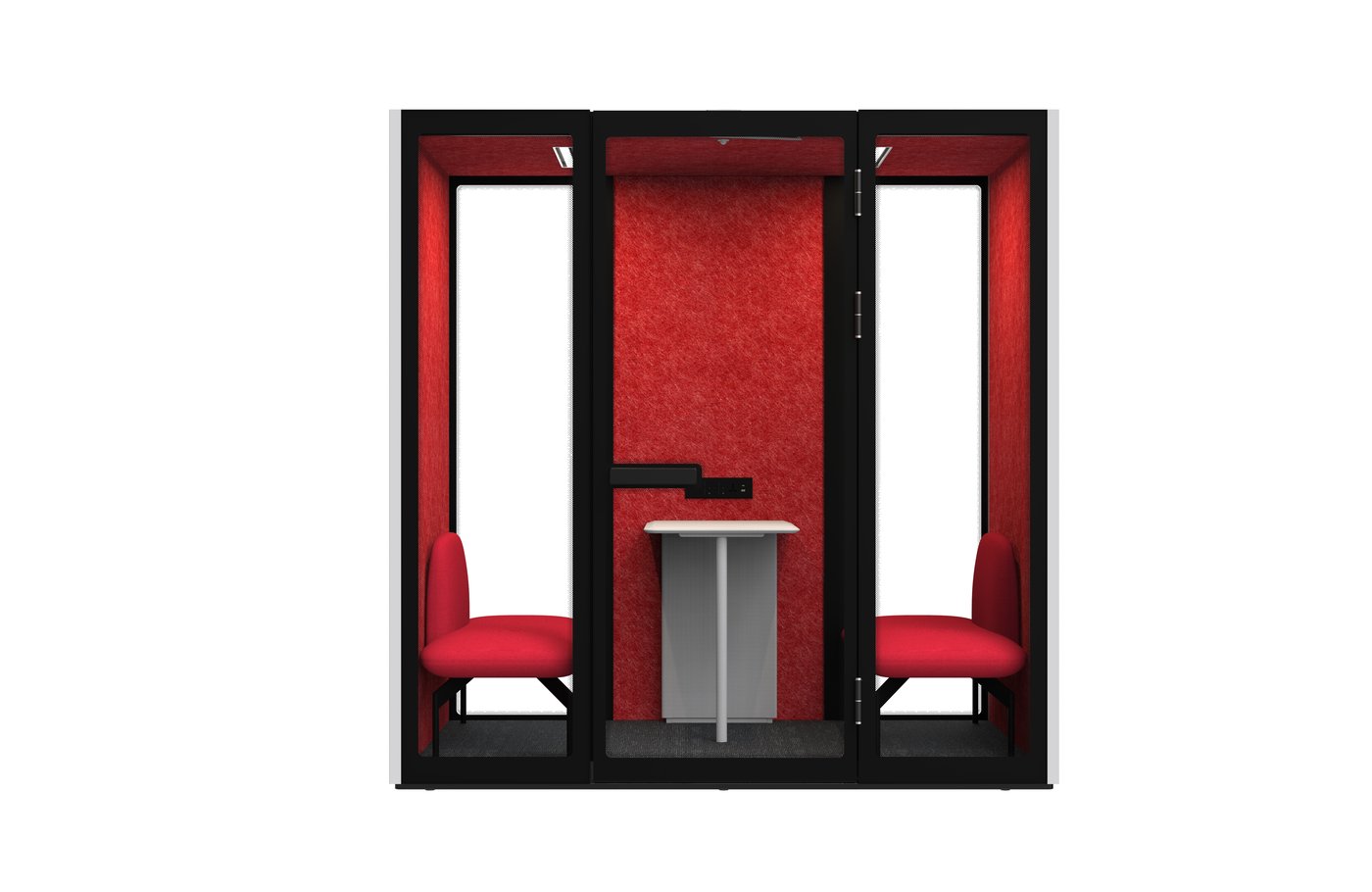
An open plan office fails quietly. The first sign is not the noise itself but the behaviour around it: headphones worn all day, meeting rooms booked solid for two-person calls, confidential conversations held in stairwells. Acoustic office pods for open plan offices fix this — but only when the pod matches the way the floor actually works. Buy by catalogue photo and you get a beautiful box that stands empty, or a queue outside the one booth everyone fights over. Buy by headcount and floor plate, and the open plan finally does what it promised.
This guide walks through the five questions we ask every client before recommending a size, drawn from the Comine Booth range we supply from Foshan and ship to more than 50 countries.
How many people will actually use the pod at the same time?
Track your meeting rooms for two weeks and a pattern appears: most "meetings" are one person on a video call or two people talking, and the eight-seat room hosts two people most of the day. Size pods for the meeting that happens every week, not the one that happens once a year.
For solo calls, booth-s is the phone pod: 0.96 m² of floor, one person, 28±3 dB of speech reduction. For deep work that needs a desk, a screen and an hour of focus, booth-m1-a gives one person a real workstation on 2.1 m². Two-person conversations — interviews, one-to-ones, pair work — fit booth-sl-a at 2.6 m². Team sessions of four belong in booth-l1-a at 2.9 m², and the six-person booth-xl-a at 4.5 m² replaces a small meeting room outright. Most open plan floors end up with a mix: several phone pods, one or two two-person pods and one four-person pod per team neighbourhood.
How much floor plate can you give up?
Every pod trades floor area for silence, so do the maths before falling in love with a model. A phone pod takes roughly 1 m² plus door swing and approach space — about 1.5 m² of honest allocation. A four-person pod with a 2.9 m² external footprint needs around 4 m² once circulation stays clear. Against the 8–12 m² per desk typical of open plan layouts, even a cluster of pods costs less space than one underused meeting room — and none of it involves construction.
Placement matters as much as area. Pods work hardest within ten steps of the desks they serve, close enough that stepping in becomes a reflex. A common planning rule of thumb is one phone pod per 15–20 open plan desks plus one two-to-four-person pod per neighbourhood, adjusted for how call-heavy each team is.
How quiet should acoustic office pods for open plan offices be?
The number to ask for is speech level reduction under ISO 23351-1 — measured on the assembled pod with the door closed and the fans running, because seals and ventilation are the two weakest acoustic points. The 28±3 dB rating of booth-s turns a phone conversation into a faint murmur a metre away. The 30±3 dB rating shared by booth-m1-a, booth-sl-a, booth-l1-a and booth-xl-a is the professional baseline wherever speech privacy matters. And remember that every extra 3 dB is clearly audible: a 25 dB pod and a 30 dB pod feel like a screen versus a room.
Will people stay inside longer than ten minutes?
Ventilation, not acoustics, decides whether a pod gets used. A sealed box with weak fans feels stuffy by minute fifteen, and the team quietly stops booking it. Match airflow to occupancy: booth-s moves 70 m³/h with two fans, booth-m1-a moves 140 m³/h, the two- and four-person pods move 280 m³/h, and booth-xl-a pushes 560 m³/h with sixteen fans — a full air change about every two minutes or better at every size. Motion sensors switch the light and fans on at entry and off when empty, and 110–220 V universal power means the same specification ships to Riyadh, Paris or Madrid without modification.
Can everyone get in — including wheelchair users?
A quiet room that excludes part of the team is a problem rebranded, not solved. The accessible-m2-a solo pod and accessible-l2-a duo pod keep the same 30±3 dB rating with a wide barrier-free entry, an automatic electric door closer, and facial recognition, QR, card or password access — no handle to grip, no threshold to cross. The duo model adds a foldable desktop for easy entry, and the solo model offers an optional height-adjustable desk, so the pod adapts to the person rather than the reverse.
How do you scale from a pilot to a whole floor?
Start with the mix, not the maximum. A pilot of ten sets — phone pods plus one two-person and one four-person unit — is enough to measure real usage by size before committing to a floor-wide rollout. Each pod installs in about 40 minutes by two people with no special tools and no downtime, so the pilot can move with the data: if phone pods queue while the four-person unit sits idle, the next order rebalances. As a factory-direct manufacturer with OEM and ODM service, BG Acoustics supports exactly this phased approach under MOQ 10 sets, with pods, PET acoustic lighting and workstation screens from one plant, one shipment and one warranty chain — because pods quiet the loud moments while felt lighting from the LUME series calms the floor in between.
Send us your floor plan and headcount, and we will return a recommended pod mix with sizes, positions and a freight estimate — no obligation. Email emmy@fsbige.com or WhatsApp +86 189 2856 2556. SILENCE SPEAKS VOLUMES.